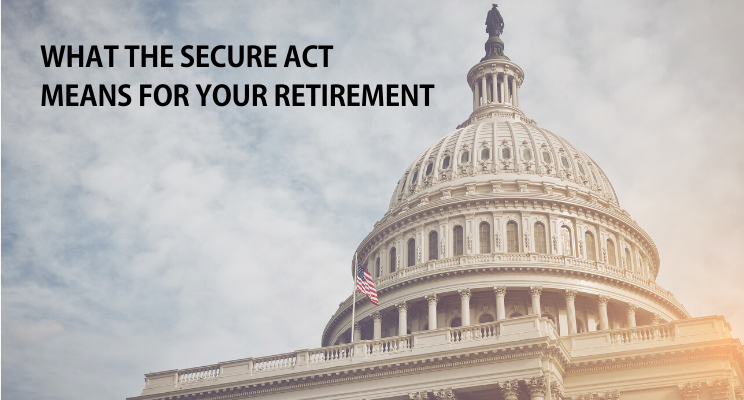
What the SECURE Act Means for Your Retirement
On December 20th, 2019, the Setting Every Community Up for Retirement Enhancement (SECURE) Act became


On December 20th, 2019, the Setting Every Community Up for Retirement Enhancement (SECURE) Act became

No financial plan is complete without an estate plan. Estate planning covers all aspects of

Did you know that 67 million people received Social Security benefits in 2017? Despite so

Retirement is one of the most important life events you will experience, and getting it

Financial planning is a lifelong endeavor, but people often seek out investment advice that doesn’t

Have you considered the emotional aspects of retirement and how to plan wisely? In today’s world,
Affiliated with Capital Investment Advisory Services, LLC.
Securities Offered Through Capital Investment Group, Inc. Member FINRA/SIPC
100 E. Six Forks Road, Suite 100, Raleigh NC 27609
(919) 831-2370
http://www.capital-invest.com/
Check the background of your financial professional on FINRA’s BrokerCheck.
Please contact us regarding your specific portfolio or financial situation. Investment products are not FDIC insured, not bank guaranteed, and may lose value. Past performance is not an indication of future results. The information contained herein does not constitute, and shall not be misconstrued as, a recommendation to purchase or sell securities.
Social Security Planning and Strategies (Zoom)
Guest Speaker – Steve Gaito
Wednesday 10/9 10am and 4pm *get in touch to RSVP
Estate Planning Musts and Must Nots (Zoom)
Guest Speaker — Chess Griffin
Tuesday, 11/19 10am and 4pm *get in touch to rsvp
Shred Day Wednesday 4/23 at our office 10am-2pm sponsored by ProShred
On December 20th, 2019, the Setting Every Community Up for Retirement Enhancement (SECURE) Act became law. As the name implies, this law intends to make it easier for Americans to save for retirement. Though this may sound simple enough, as with most laws, the reality is far more complex. The SECURE Act includes changes that affect everyone from beneficiaries of retirement accounts to those with student loans, but the SECURE Act is most likely to affect those either approaching retirement or recently retired. Your unique financial situation will dictate exactly how the SECURE Act will impact you and your retirement plan, but there are a few key changes that everyone should take note of when planning for retirement.
Increase in Required Minimum Distribution AgeAn important consideration for many when planning for retirement is the Required Minimum Distribution (RMD), which is the amount you’re required to take out of tax-deferred retirement savings accounts such as traditional IRAs, 401(k)s, 403(b)s, and 457s. The SECURE Act increases the age at which you must begin taking RMDs from 70 ½ to 72. There are a few reasons why an increased RMD age can help save for retirement, including giving your portfolio more time to grow, offering more time to roll your money into a Roth IRA (which does not have RMDs), and minimizing your tax burden by decreasing taxable income. Though this change begins in 2020, it is not retroactive, meaning that if you turned 70 ½ prior to 2020, you must still take RMDs. Only those who turn 70 ½ beginning in 2020, may choose to wait to take RMDs until turning 72.
Increase in Age for IRA ContributionsRMDs are not the only area where the SECURE Act increased ages relating to retirement accounts. Before the passage of the SECURE Act, you could not make contributions to a traditional IRA after turning 70 ½. The SECURE Act has raised that age to 72, as long as you have earned income. This gives people more time to increase their retirement savings. Like the updates to RMDs, this change is not retroactive, meaning you still cannot make contributions to a traditional IRA for the 2019 tax year if you are over 70 ½.
Elimination of Stretch IRAsThe elimination of what was known as a stretch IRA may impact the financial planning of many individuals. This allowed beneficiaries of IRAs to “stretch” the RMDs throughout their lifetime. Now, those who inherit an IRA, 401(k), or other defined benefit plan, must take all distributions within ten years of inheriting the account. Certain groups are exempt from the changes including spouses, people with disabilities, and those within ten years of the age of the account holder. Those who are minors will not be affected immediately, but once the minor reaches the age of majority, he or she then has ten years to take the distributions.
The SECURE Act does not affect those who have already inherited IRAs. The changes will affect only those who inherit applicable retirement accounts from account holders who pass away after January 1, 2020. If you are an account holder, you may want to review the beneficiaries of your accounts, and potentially update your estate plan.
More Options for Part-Time WorkersThe SECURE Act increases the number of workers eligible for retirement savings plans. Previously, employees weren’t always eligible to participate in their company’s 401(k) plan if they worked less than 1,000 hours annually (an average of about 19 hours a week). The SECURE Act still requires companies with a 401(k) plan to offer the plan to those who work 1,000 hours or more in one year, but the law also expands eligibility to those who have worked 500 hours annually for three consecutive years.
Incentives to Help Small Business OwnersThe SECURE Act incentivizes small business owners to start retirement accounts through a tax credit. Small businesses, defined as businesses with less than 100 employees, are eligible for up to $5,000 in tax credits. For every non-highly compensated employee who is eligible to participate in the retirement account, there is a $250 credit. Companies would be eligible for the credits over a three-year period beginning in 2020. The tax credit applies to SEP IRAs, SIMPLE IRAs, and profit-sharing plans, as well as 401(k)s.
The SECURE Act also encourages small business owners to offer retirement savings plans by making it more appealing to participate in multiple employer plans (MEPs). MEPs allow companies to offer high-quality retirement savings plans at low cost to the employer. But many employers were hesitant to join due to the “one bad apple” rule, which stated that all employers in a plan would deal with the tax consequences if one employer did not satisfy the tax qualification rules. The SECURE Act removes the “one bad apple” rule, making MEPs far more appealing to small business owners.
Education ExpensesThose who are approaching retirement and have children in college or other higher education programs may be impacted by the SECURE Act’s changes to rules surrounding education expenses. Funds from a 529 plan can now be used to cover student loans up to $10,000 per child. The SECURE Act also allows funds from a 529 plan to be put towards some apprenticeship programs and allows those earning stipends, such as those in graduate school or working on a post-doc, to count that money as compensation for the purposes of contributing to a traditional IRA.
Contact us if you have questions about how the SECURE Act may affect your unique financial situation and plans for retirement.
Sources
https://www.forbes.com/sites/nextavenue/2020/12/31/6-ways-the-secure-act-may-impact-your-retirement/#1786156f672a
https://www.fidelity.com/learning-center/personal-finance/retirement/understanding-the-secure-Act-and-retirement
https://www.forbes.com/sites/davidkudla/2020/01/10/four-major-highlights-of-the-secure-act/#6d66cf2576b1